In September 2025, Nvidia announced two key decisions:
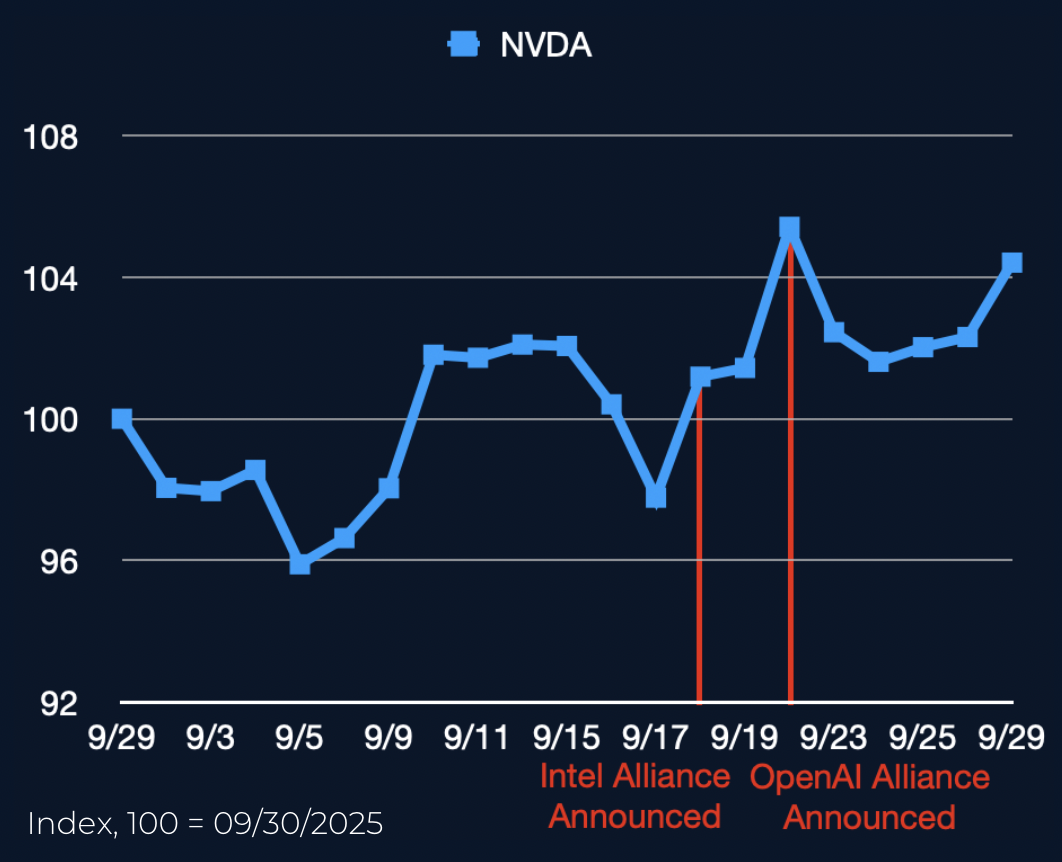
- 09/18 → Investment of USD 5 billion in Intel and an agreement to co-develop chips for AI PCs and data centers.
- 09/22 → Commitment of up to USD 100 billion in OpenAI to deploy 10 GW of Nvidia systems aimed at training and operating AI models.
These announcements consolidate Nvidia as a central player in the transition to artificial intelligence and had a strong impact on the markets.
Impact on the Market
- Nvidia: the stock closed up 3.5% on 09/18 (Intel alliance) and 3.9% on 09/22 (OpenAI alliance).
- Intel: the stock rose 22.7% at the close on 09/18, driven by Nvidia’s strategic validation.
- AMD: fell as much as 5% intraday on 09/18, and closed down 0.78%, reflecting fears of intensified competition.
- Market interpretation: optimism is evident, but much of the rally is based on expectations, which may lead to volatility.
Competitive Landscape
- Nvidia: secures future demand (OpenAI from 2026) and strategic validation (Intel from 2027).
- Intel: gains support after years of lagging performance, though results will only be seen from 2027 onward.
- AMD: keeps its lead in AI PCs and seeks to grow in data centers, under greater pressure.
- TSMC/Samsung: continue to lead in manufacturing; the Intel alliance seeks to reduce Nvidia’s dependence on TSMC over the long term.
Overall, these alliances strengthen Nvidia’s strategic position, though competition and tangible benefits will only materialize in the medium term.
Outlook
Investors can expect more optimism around Nvidia, along with a more demanding competitive landscape for Intel and AMD. However, the recent rally is driven more by expectations than fundamentals and could bring volatility.
At Numa, we closely monitor these developments to capture opportunities through our Hefa strategy, with around 70% invested in Nvidia, reaffirming its key role in creating value for our clients.


